Best Electric Pressure Washers (2026): 3 Models That Actually Cleaned My Driveway
Every spring, the same argument: rent one, borrow one, or finally buy one. The rental is $60/day and always gone on weekends. The borrowed one never has all the nozzles. And once you've used a pressure washer on a driveway, the garden hose looks like a joke. The Sun Joe SPX3000 is the right answer for most people — 20,000 reviews at 4.8 stars is a consensus you can trust. But if your list is just a car and a small patio, the Greenworks at $99 is enough. And if you want something that rolls and feels like a tool rather than an appliance, the Ryobi is worth the extra money. This page maps each model to the buyer it was built for.
Quick Answer: Which Pressure Washer Should You Buy?
- →Most homeowners with a driveway, deck, or siding: Sun Joe SPX3000 — 20,000 reviews, 4.8 stars, dual soap tanks, $149. This is the default right answer.
- →Budget buyers — just need to wash a car and clean the patio: Greenworks GPW1501 — 1500 PSI, 17 lbs, ~$99. Lightest and cheapest; works great for light-to-medium tasks.
- →Larger properties, frequent use, want a rollable machine: Ryobi 2000 PSI — flat-free wheels, 25-ft hose, metal wand. Built to move around.
Quick Comparison: All 3 Models
| # | Model | PSI | Weight | Hose | Stars | Best For |
|---|---|---|---|---|---|---|
| 1 | Sun Joe SPX3000 | 2030 PSI | 24.3 lbs | 20 ft | 4.8★ · 20,000+ | Driveways, decks, siding, cars — the default right answer |
| 2 | Greenworks GPW1501 | 1500 PSI | 17 lbs | 20 ft | 4.4★ · 8,000+ | Cars, patio furniture, fences, light concrete — budget buyers |
| 3 | Ryobi 2000 PSI | 2000 PSI | 29 lbs | 25 ft | 4.5★ · 5,000+ | Larger properties, frequent use, buyers who want to roll it around |

Sun Joe SPX3000
The most-reviewed electric pressure washer on Amazon. 4.8 stars across 20,000+ reviews. 2030 PSI certified pressure through a 14.5-amp motor. The feature that separates it from everything else at this price: dual detergent tanks that let you load two soap types simultaneously and switch with a dial. Five quick-connect nozzles cover every surface from bare concrete to car paint. If you have a driveway, deck, or siding that needs work, this is the one.
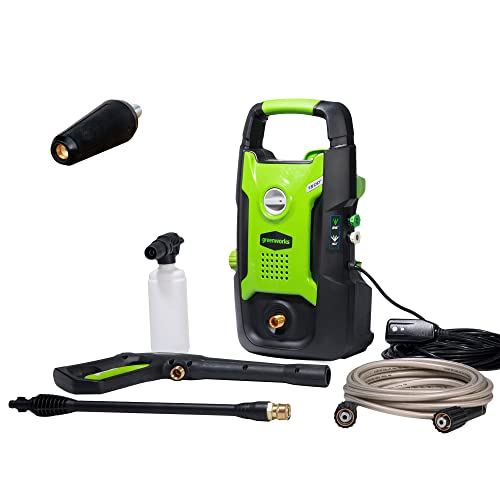
Greenworks GPW1501
At ~$99 and 17 pounds, the Greenworks is the lightest and cheapest of the three — and it delivers real cleaning power for light-to-medium tasks. Car wash, patio furniture, fences, wood decks with light moss: the GPW1501 handles all of it. The turbo nozzle included in this variant adds an extra 50% cleaning punch on hard surfaces. Where it falls short vs. the SPX3000: no dual soap tanks, 500 fewer PSI, and less motor. If your cleaning list is a car and a small patio, save the $50.

Ryobi 2000 PSI
The Ryobi sits between the SPX3000 and a gas machine in terms of design philosophy: flat-free wheels and a telescoping handle make it genuinely rollable around a property rather than carried. At 2000 PSI and 13 amps, it's comparable to the SPX3000 in raw output. Where it wins: the 25-ft hose gives more reach, and the build quality is notably more solid — metal wand, more robust connectors. Where it loses: heavier, costs more, and doesn't include the dual soap tank system.
How to Choose: 3 Questions
Question 1: What are you cleaning?
- Car, patio furniture, small patio: Greenworks at $99 is enough. Save the $50.
- Driveway, deck, siding, house exterior: SPX3000 — 2030 PSI handles all of it. The dual soap tanks are a genuine advantage here.
- Large property, frequent cleaning, commercial-adjacent: Ryobi or step up to a gas machine.
Question 2: How often will you use it?
- A few times a year (spring clean, occasional car wash): Any of the three. The Greenworks makes the most economic sense for infrequent use.
- Monthly use, multiple cleaning tasks: SPX3000 or Ryobi — the better build quality pays off over time.
- Weekly use, multiple tasks per session: Ryobi for durability; gas for commercial-level output.
Question 3: Where will you store it?
- Small garage or shed, storage is tight: Greenworks at 17 lbs is the easiest to tuck away.
- Standard garage with a corner to spare: SPX3000 at 24 lbs stores upright easily.
- Garage with roll-in space: Ryobi with its wheels rolls into a corner and stands on its own.
Gas vs. Electric: When Electric Is Enough (And When It Isn't)
Gas pressure washers start at 3,000 PSI and can hit 4,000+. They're louder, heavier, require gas/oil maintenance, and produce carbon monoxide — you can't use them in enclosed spaces. Electric pressure washers top out around 2,000–2,500 PSI, are quieter, require zero maintenance beyond storage, and run off a standard outdoor outlet.
For 95% of homeowner tasks — driveways, decks, siding, cars, patios — 2030 PSI is sufficient. Where gas genuinely wins: stripping paint, cleaning large commercial concrete, removing oil stains that are years deep, or professional-grade work where you need to run for hours at a time. For a typical suburban home, electric is cleaner, simpler, and saves you $200-400 over the equivalent gas machine.
Individual Pressure Washer Reviews
Get our best picks in your inbox
No spam. Just honest Amazon reviews, once a week.
Unsubscribe any time. We'll never sell your address.